How to Avoid Doorway Pages and Doorway Abuse
Learn how to avoid doorway pages and doorway abuse to improve your website and its visibility on Google.
Doorway Pages and Doorway Abuse
Today we discuss a topic that has cost many websites a lot of money (and sleep) over the years: doorway pages and the infamous doorway abuse.
If you have a blog, a website for your business, or you are simply curious about how Google works, this information is relevant to you.
First of all:
what is a doorway page?
Imagine searching on Google for the best plumber in Vercelli and landing on a page that says exactly that... but it is empty. Just a title repeated 50 times, some copied text, and a button (or an automatic redirect) that takes you to the homepage of a company 200 km away.
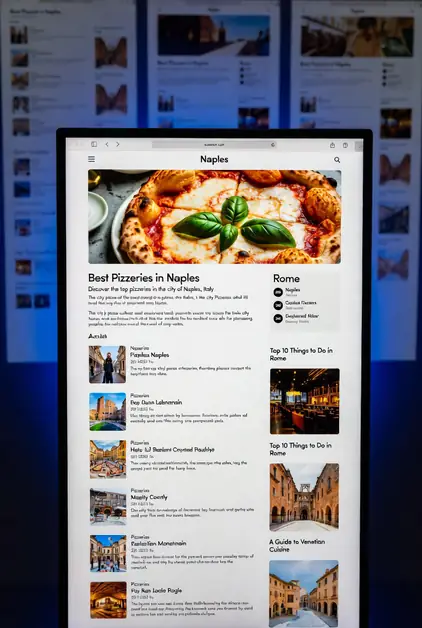
That is a doorway page: a page created solely to deceive Google and attract clicks, but that provides nothing useful to those who arrive there. They are often clones: same structure, only the city or keyword changes (Rome, Milan, Naples...).
In the 2000s to 2010, this was a very common tactic.
And what about doorway abuse?
Doorway abuse is when you create a system: hundreds or thousands of nearly identical pages, all aimed at intercepting variations of similar keywords, all redirecting to the same real page or with super thin content. Where thin content means minimal or repetitive text, superficial information, no original depth.
Google calls it abuse because: - It deceives the user (promises value, delivers nothing) - It deceives the algorithm (artificially inflates results) - It ruins the overall quality of the web
The result?
Heavy penalties: the site disappears from searches or plummets in ranking.
The evolution: from tolerated to banned.
- 2000s: Doorway pages everywhere. Google was young, algorithms naive. Many took advantage of it. - 2003 – Florida Update: The first serious blow. Google begins penalizing over-optimized pages filled with repeated keywords. Many doorway pages end up forgotten. - 2011–2014: Google files patents to detect pages that change topics or are duplicates. The message is clear: we are watching you. - March 2015 – Doorway Pages Update: The turning point. Google officially announces: Doorway pages created solely for search engines are spam. Sites with tens of thousands of useless pages lose traffic overnight. - 2020–2026 (today): With ongoing Spam Updates (the latest major one in August 2025), Google uses AI to automatically identify them.
Duplicate content?
Suspicious redirects?
Mass-created thin pages?
Manual penalties or de-indexing. By 2026, there is no escape: if you try to create them, the site dies.
Google's rule is always the same: provide real value to the user. Period.
Frequently Asked Questions
But is a single page with a redirect already a doorway?
No, not necessarily. If it is useful and transparent (e.g., a landing page that clearly explains and then leads to the product), it is fine. The problem arises when it is made solely to rank and nothing else.
Can I create pages for every city/product?
Yes, but only if each page has unique, useful, and different content (real reviews, maps, local photos, personal experiences). If you copy-paste changing only Turin to Isernia, it is 100% doorway abuse.
What should I do instead in 2026?
- Write deep and original articles - Focus on real local content - Use natural long-tails, not forced ones. For example: use “where to park for free in Polignano a Mare in summer,” not isolated keywords like “parking Polignano.” - Improve user experience: fast, mobile-friendly, useful
I believe Google has done well to tighten up: at least it tries to keep the web cleaner, now that many articles are written by bots.
See you next time, https://www.linkedin.com/in/pietro-fischetto/