AI slop, scaled content, and abuse: what are the differences
Producing a lot does not mean creating subpar material or manipulating Google: here’s why these three phenomena should be distinguished
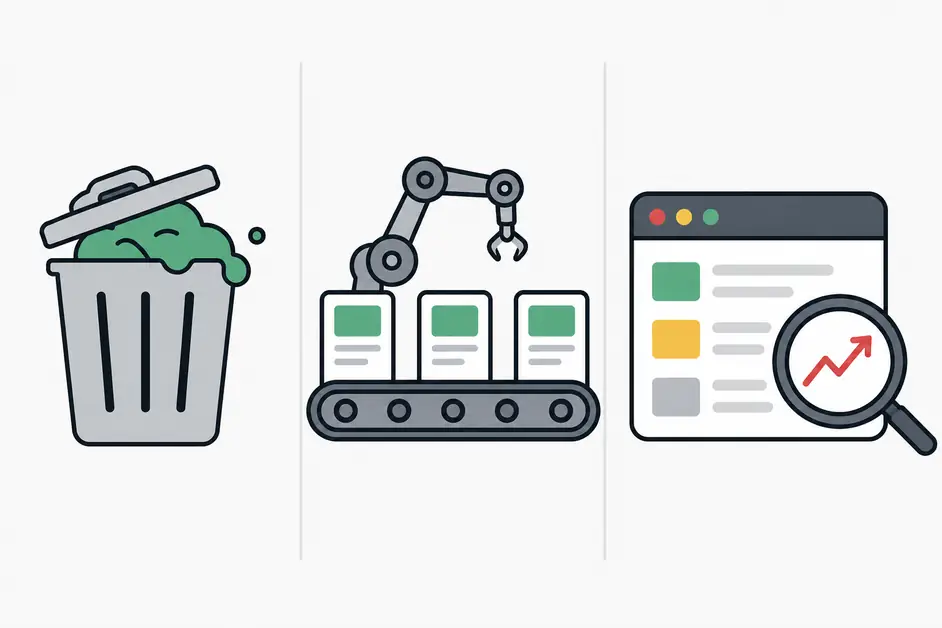
AI slop, scaled content, and scaled content abuse are related. But they don't mean the same thing. AI slop describes the quality of the result. Scaled content describes how the content gets made. Scaled content abuse means producing content at scale. The goal is to manipulate search results. So content can fit one category without fitting the others.
Scaled content comes from a process that produces lots of content quickly. AI has made that possible for almost anyone. Work that once needed many writers can now be automated. But producing content at scale doesn't automatically make it bad. Hundreds of pages can still be checked and revised. They can include original information before they're published.
When scaled content becomes AI slop or abuse
AI slop, on the other hand, is about the result. It's AI-generated content made with little care. Think wordy articles that say little, mass-produced images, irrelevant videos, and automatically published posts. Here, the problem isn't how much content gets made. It's how little value that content offers. Even one article copied straight from ChatGPT can count as slop. That's true if it's published without anyone checking it. It doesn't need to be part of a large operation.
Scaled content abuse adds a third dimension. Google uses this term for creating lots of pages. Their main purpose is to manipulate search rankings, not help users. AI can be used to do this. But so can traditional automation, human writers, or both. So AI itself isn't the problem. The problem is producing content at scale to manipulate rankings.
The relationship between these three ideas is simpler now. Scaled content describes production volume. AI slop describes poor-quality results. Scaled content abuse describes the intent behind mass production. A site could publish thousands of pages without producing slop. It could also avoid scaled content abuse. Those pages just need to be genuinely useful. They should meet real user needs.
The worst case is when all three overlap. AI generates huge amounts of poor-quality content. The main goal is visibility in search results. That's where AI slop, scaled content, and scaled content abuse meet. They describe three sides of the same problem.