EXIF in Photos: What They Are and Why You Should Remove Them from Your Blog
EXIF data are hidden in photos: GPS, date, phone model. Discover what they contain and why you should remove them.
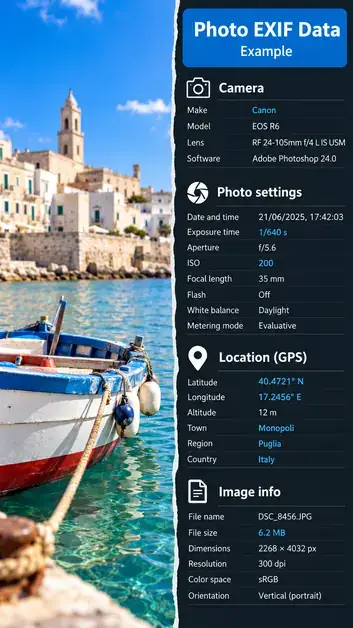
EXIF is a hidden record inside a photo. It's created automatically when you take the picture. You can't see it, but it stays in the file. Anyone who downloads the photo can read it. They just need one of many free tools. For example, try https://onlineexifviewer.com/https://onlineexifviewer.com/.
So what's in this record? First, there are camera details. These include your phone or camera's make and model. You'll also find the lens and software version.
Then come the shot details. These include the exact date and time. You'll also see exposure time, aperture, and ISO setting. Flash use, zoom, and focal length may appear too.
The most sensitive part is the location data. Photos can contain GPS coordinates: latitude and longitude. Sometimes they include altitude too. They may even show which direction the camera faced.
Finally, there are image details. These include pixel dimensions, resolution, and a small preview. They also show whether the photo is portrait or landscape.
Finally, photos sometimes contain personal information. That includes the author's name, copyright details, and camera serial number. You might also find comments added by editing software.
So why remove it? First, it doesn't help with SEOSEO. Google doesn't use this data to rank websites. Geotags in photos won't help you appear in local searches. What matters is the filename, alt text, and surrounding text.
Second, there's file size. Hidden data takes up space. It's only a few kilobytes per photo. But on a blog with lots of images, that adds up. Smaller files help pages load faster. And Google considers site speed when ranking pages.
Third, there's privacy. GPS coordinates can reveal where you took a photo. If you took it at home, someone could find your address. The date and phone model reveal things about your habits.
There's a fourth reason, too: mistakes. A photo might show the wrong location, time, or author. Remove that data, and only your chosen details remain.
In short, EXIF data helps photographers and photo editors. But it's useless when you're publishing photos on a blog. Removing it makes photos smaller and safer. And it won't hurt your SEO.